Monday, 25 March 2013
Carbol fuchsin
Carbol fuchsin, carbol-fuchsin, or carbolfuchsin, is a mixture of phenol and basic fuchsin, used in bacterial staining procedures. It is commonly used in the staining of mycobacteria as it has an affinity for the mycolic acids found in their cell walls.
It is a component of Ziehl-Neelsen stain. Carbol fuchsin is used as a dye to detect [acid fast bacteria] because it is more soluble in the cells wall lipids than in the acid alcohol. If the bacteria is acid fast the bacteria will retain the initial red color of the dye because they are able to resist the destaining by acid alcohol.
Carbol-fuchsin is also used as a topical antiseptic.

Dieterle stain
The Dieterle stain is a way of marking tissue for microscopic examination.
It is used to find the organisms that cause cat-scratch disease and syphilis and sensitive for mycobacterium tuberculosis.
Treponema pallidum particle agglutination assay
The treponema pallidum particle agglutination assay (also called TPPA test) is an indirect agglutination assay used for detection and titration of antibodies against the causative agent of syphilis, Treponema pallidum subspecies pallidum.
In the test, gelatin particles are sensitized with T. pallidum antigen. Patient serum is mixed with the reagent containing the sensitized gelatin particles. The particles aggregate to form clumps when the patient serum is positive for syphilis. In other words, the patient's serum contains antibodies to T. pallidum. A negative test shows no clumping of gelatin particles. This is a type of specific treponemal test for syphilis.
Rapid plasma reagin
Rapid Plasma Reagin (RPR) refers to a type of test that looks for non-specific antibodies in the blood of the patient that may indicate that the organism (Treponema pallidum) that causes syphilis is present. The term "reagin" means that this test does not look for antibodies against the actual bacterium, but rather for antibodies against substances released by cells when they are damaged by T. pallidum.
In addition to screening for syphilis, an RPR level (also called a "titer") can be used to track the progress of the disease over time and its response to therapy.
Friday, 8 March 2013
Sailor Stars Song
Give sadness now a sailor smile
Bringing a miracle, a sailor wing
Everybody carries a shining star inside
I won't give up! To tomorrow, a sailor yell
For sure! I will catch it! The sailor star
Let this vow sound through the whole galaxy
After the time when you disappeared from me
I began my journey searching for you
The start is on the map, the stenciled picture of an angel
The destination it points to, a waiting dark colisseum
In my trembling heart, the secret kiss of that day
However hard destiny may be
I will keep following it
I won't look back, with my sailor eyes
Reaching out to you, with my sailor wind
This song is the guidepost of the stars
I won't give up! To tomorrow, a sailor yell
For sure! I will find it! The sailor star
With the wings of an angel, I take off
Alone I run along the road of the unknown
At last I have arrived, here at this fort
At the bottom of the flask, which you left behind
A single piece of the star of trial, now chant the magic spell
This is our miraculous destiny
The past and the future, crossing them all, to catch up with you
Give sadness now my sailor eyes
Bringing a miracle, a sailor wing
Everybody carries a star of fate inside
I won't give up! To tomorrow, a sailor yell
For sure! I will catch it! The sailor star
Let this vow sound through the whole galaxy
I won't look back, with my sailor eyes
Reaching out to you, with my sailor wind
This song is the guidepost of the stars
I won't give up! To tomorrow, a sailor yell
For sure! I will find it! The sailor star
With the wings of an angel, I take off
Friday, 15 February 2013
Nanosequencing
-based on the electrical characterization of individual nucleobases
A nanopore is simply a small hole, of the order of 1 nanometer in internal diameter. Certain porous transmembrane cellular proteins act as nanopores, and nanopores have also been made by etching a somewhat larger hole (several tens of nanometers) in a piece of silicon, and then gradually filling it in using ion-beam sculpting methods which results in a much smaller diameter hole: the nanopore. Graphene[3] is also being explored as a synthetic substrate for solid-state nanopores.
The theory behind nanopore sequencing is that when a nanopore is immersed in a conducting fluid and a potential (voltage) is applied across it, an electric current due to conduction of ions through the nanopore can be observed. The amount of current is very sensitive to the size and shape of the nanopore. If single nucleotides (bases), strands of DNA or other molecules pass through or near the nanopore, this can create a characteristic change in the magnitude of the current through the nanopore.
Alpha hemolysin (αHL), a nanopore from bacteria that causes lysis of red blood cells. bind an exonuclease onto the αHL pore. The enzyme would periodically cleave single bases, enabling the pore to identify successive bases. Coupling an exonuclease to the biological pore would slow the translocation of the DNA through the pore, and increase the accuracy of data acquisition.
homomeric αHL pore that has a ring of seven ardinines
located near the barrel of the pore. To bring the diameter of
the conducting pathway closer to the size of the DNA a
cyclodextrin adapter is fitted within the pore.
Mycobacterium smegmatis porin A (MspA) is the second biological nanopore currently being investigated for DNA sequencing. A natural MspA, while favorable for DNA sequencing because of shape and diameter, has a negative core that prohibited single stranded DNA(ssDNA) translocation. The natural nanopore was modified to improve translocation by replacing three negatively charged aspartic acids with neutral asparagines.
A nanopore is simply a small hole, of the order of 1 nanometer in internal diameter. Certain porous transmembrane cellular proteins act as nanopores, and nanopores have also been made by etching a somewhat larger hole (several tens of nanometers) in a piece of silicon, and then gradually filling it in using ion-beam sculpting methods which results in a much smaller diameter hole: the nanopore. Graphene[3] is also being explored as a synthetic substrate for solid-state nanopores.
The theory behind nanopore sequencing is that when a nanopore is immersed in a conducting fluid and a potential (voltage) is applied across it, an electric current due to conduction of ions through the nanopore can be observed. The amount of current is very sensitive to the size and shape of the nanopore. If single nucleotides (bases), strands of DNA or other molecules pass through or near the nanopore, this can create a characteristic change in the magnitude of the current through the nanopore.
Alpha hemolysin (αHL), a nanopore from bacteria that causes lysis of red blood cells. bind an exonuclease onto the αHL pore. The enzyme would periodically cleave single bases, enabling the pore to identify successive bases. Coupling an exonuclease to the biological pore would slow the translocation of the DNA through the pore, and increase the accuracy of data acquisition.
homomeric αHL pore that has a ring of seven ardinines
located near the barrel of the pore. To bring the diameter of
the conducting pathway closer to the size of the DNA a
cyclodextrin adapter is fitted within the pore.
Mycobacterium smegmatis porin A (MspA) is the second biological nanopore currently being investigated for DNA sequencing. A natural MspA, while favorable for DNA sequencing because of shape and diameter, has a negative core that prohibited single stranded DNA(ssDNA) translocation. The natural nanopore was modified to improve translocation by replacing three negatively charged aspartic acids with neutral asparagines.
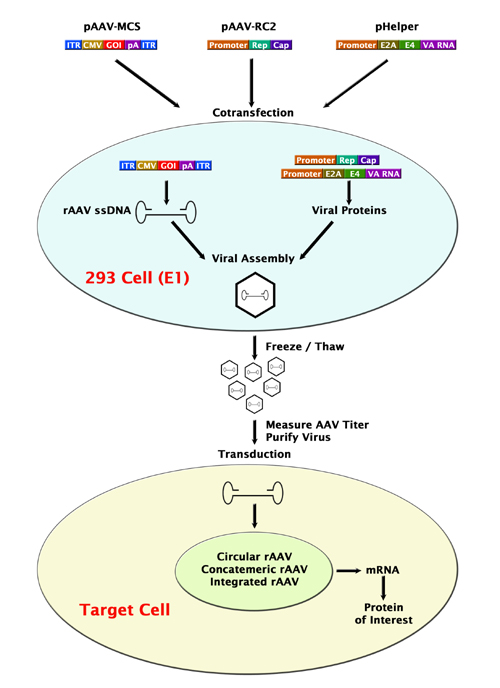
Co-transfection
1. Viral proteins + cDNA --> Virus --> transduction --> produce protein of interest
2. Cre/loxP recombination --> gene disturbance / addition of a gene
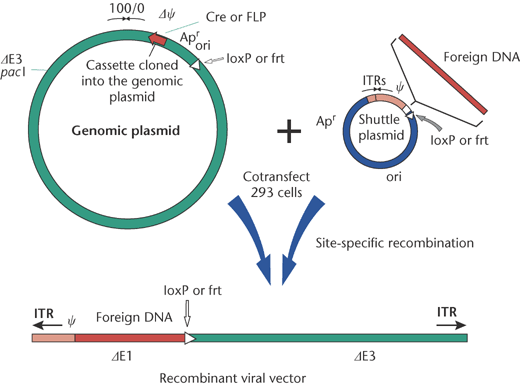
2. Cre/loxP recombination --> gene disturbance / addition of a gene
Subscribe to:
Posts (Atom)